What Is RAG (Retrieval Augmented Generation)? Explained in Plain English
RAG is one of the biggest AI buzzwords of 2026. Here is what it actually means, how it works, and why data analysts should understand it, explained without the jargon.
You have probably heard the term RAG floating around in AI conversations lately. It sounds technical, but the idea behind it is actually very simple. Let's break it down without the jargon.
The exam analogy
Imagine two students taking the same exam.
Student A has to answer purely from memory. Whatever they learned months ago is all they have. If the question is about something recent, or something very specific to your company, they simply do not know it, so they guess. Sometimes that guess sounds confident even when it is wrong.
Student B is allowed to open a folder of relevant notes before answering. They read the exact information they need, then write their answer using that.
Student B is going to give you a more accurate answer, almost every time. That is exactly what RAG does for an AI model.
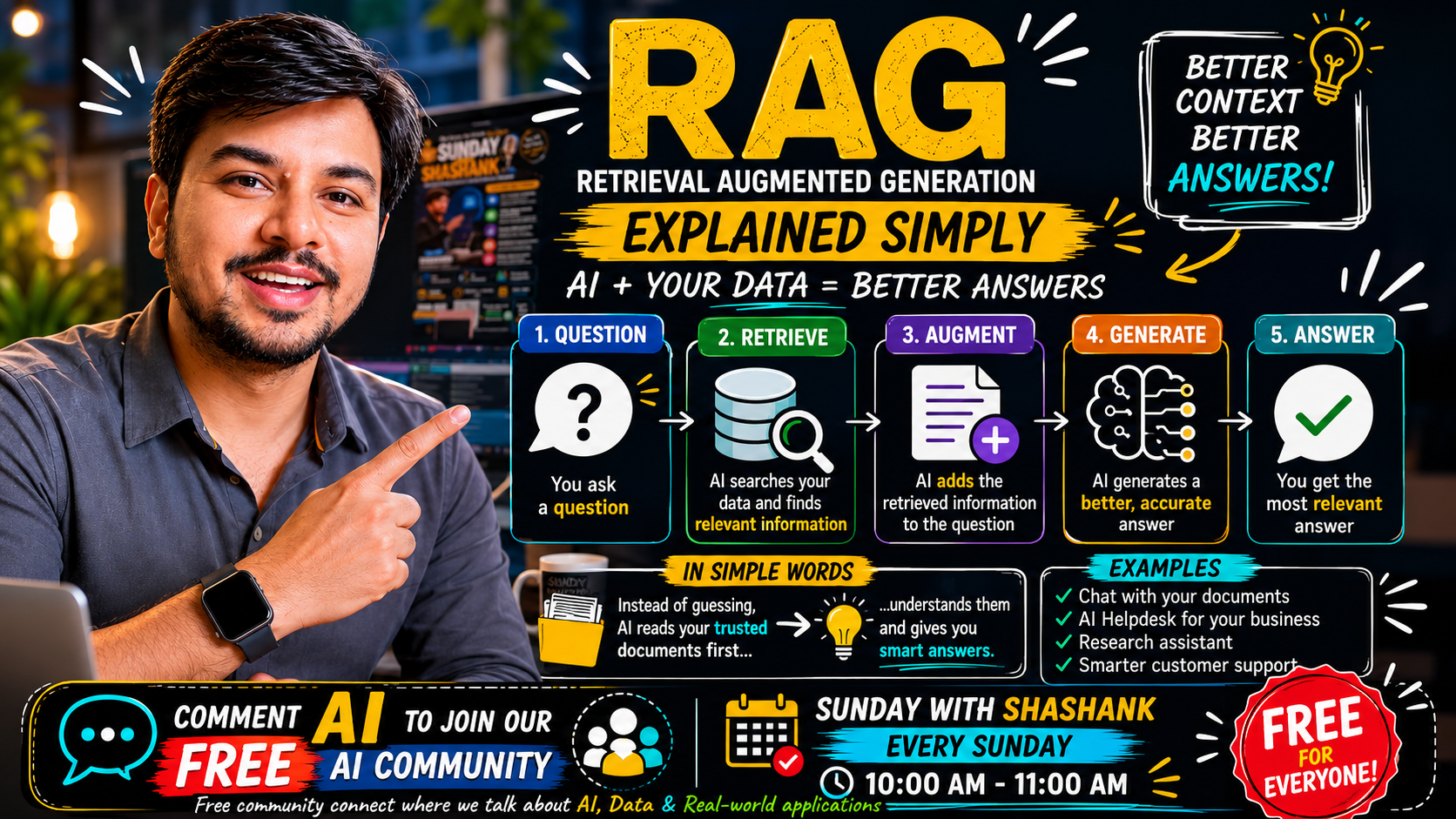
RAG stands for Retrieval Augmented Generation. In plain English: the AI retrieves (looks up) real information first, then generates (writes) its answer using that information, instead of relying only on what it memorised during training.
Why this matters
A normal AI model like ChatGPT or Claude is trained on a huge amount of text, but that training has a cutoff date, and it does not know your company's private documents, your product catalogue, or your latest data. If you ask it something outside that training, it can make something up that sounds correct but is not. This is called hallucination.
RAG fixes this by connecting the AI model to a live source of information, like your documents, a database, or your website content. Before the AI answers, it searches that source for the most relevant pieces of information, and then writes its answer based on what it actually found.
How it actually works, step by step
- Ingestion — Your documents (PDFs, spreadsheets, web pages, notes) are broken into smaller chunks and converted into a format the AI can search, called embeddings
- Retrieval — When someone asks a question, the system searches those chunks and pulls out the ones that match the question best
- Augmentation — Those matching chunks get added into the AI's prompt, along with the original question
- Generation — The AI reads the question plus the real information, and writes an answer grounded in that information
Next time you use an AI tool that says it "searches your documents" or "chats with your PDF," that is RAG working behind the scenes. Try asking it something you know is only in your uploaded file, and see how it points back to the actual source.
A simple business example
Say a small business owner uploads their return policy, pricing sheet, and FAQs into an AI chatbot. Without RAG, the chatbot might guess at answers about pricing and get it wrong. With RAG, the chatbot searches those actual documents first, and answers customers using the real, current policy, not a guess.
This is exactly why RAG has become one of the most common ways businesses are building their own AI chatbots and internal tools in 2026.
Why data analysts and AI learners should care
RAG is not just for engineers building chatbots. If you work with data, understanding RAG helps you in a few practical ways:
- You can explain to your team why an AI answer is trustworthy or not, based on whether it is actually grounded in real data
- You can spot when a company's "AI assistant" is likely to make things up versus actually search real information
- It gives you a stepping stone into building your own small AI tools on top of your company's own data, using tools like a vector database and a language model together
Common mistakes people make
- Assuming RAG makes an AI 100 percent accurate. It reduces made-up answers, but it does not eliminate them completely
- Feeding the AI messy, outdated, or duplicate documents, which leads to messy, outdated answers
- Skipping the step of checking whether the AI actually used the retrieved information, instead of ignoring it and guessing anyway
The honest caveat
RAG is a powerful pattern, but it is not magic. A RAG system is only as good as the documents you feed it and the quality of the search step. Good, clean, well-organised source data still matters more than the AI model itself.
Where to go from here
If this is your first time hearing about RAG, you do not need to build one today. Start by understanding your own data clearly, since that is the foundation every RAG system depends on. If you want to see where your own data and AI skills stand today, take Flexing Data's free AI Readiness Assessment, or explore the free Labs to start building practical, job ready skills at your own pace.
Ready to turn reading into a career?
Get your free data-readiness score and a personalised roadmap in 10 minutes.
🎯 Take the free assessment📖 Keep reading
Is RAG Dead in 2026? What the Debate Actually Means for You
A viral post says RAG is dead. The truth is messier and more useful to know. Here is what actually changed, in plain English, and whether you should still bother learning retrieval.
Read article →What Is a Vector Database? A Plain-English Guide for Data Analysts (2026)
Every AI tool you use, from ChatGPT search to your company's internal chatbot, leans on something called a vector database behind the scenes. Here is what it actually does, in plain English, and whether you need to learn it.
Read article →ChatGPT vs Claude vs Gemini: Which AI Should Data Analysts Actually Use in 2026?
All three AI tools can analyse your data now, so the question isn't which one is smartest. It's which one fits your actual workflow. Here's the honest breakdown for beginners.
Read article →